As a member of the Vertically Challenged Featherweight Brigade (5'6", 29"leg, 10stone), I have decided to lower the bike slightly. In standard trim I have no problems whilst riding but occasionally feel vulnerable when manoeuvring very slowly in traffic or man-handling in and out of the garage. Lowering the centre of gravity and enabling feet to touch the ground more securely has improved things for me.
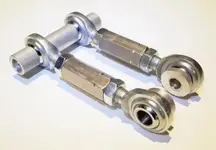
I opted for the Soupy's lowering link:-
View attachment 3027
This turnbuckle design uses left and right-hand threaded Rose-type joint ends. When installed, the ride height can be adjusted anywhere between minus 1" and minus 4" by turning the centre turnbuckle section. This link replaces the lower dog-bone rear suspension link.
Support the bike so that the rear wheel is off the ground and the suspension is fully relaxed. I used tie-down straps between the frame and my garage overhead beam. I also has straps between handlebars and garage walls, thus holding the bike from moving side to side. I also had a paddock stand in place on the rear wheel and scissors jack under the sump.
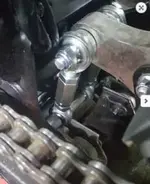
Remove both silver side trim plates (2 screws + 1 grommet). Remove the top bolt from the original dog-bone. The paddock stand helps by easing the weight during bolt withdrawal. Remove the nut from the lower dog-bone bolt. Remove the two side-stand bolts and let the stand hang free. On right side of bike, remove the main rear suspension swinging arm nut (22mm). On left side, remove the main lower fixing bolts to the side plate for the swinging arm pivot. Carefully drift the main swinging arm bolt from the right side until it just allows the left side plate to move left about 30mm. Now try to withdraw the lower dog-bone bolt. It may be necessary to tap the main swinging arm bolt a little to achieve more clearance. Once the lower dog-bone bolt is removed, wangle the link plus its sleeve and bearing out from location.
Fit the Soupy's links as per simple instructions. Reassemble and retorque.
View attachment 3028
Before fitting the new adjustable links, I confirmed that they were both identical in length. Once fitted, it is important that adjustments are made identically to both links, to avoid stress and twisting.
I have set mine so that my seat height is now 30mm lower than stock. Original seat height was 795mm. Mine is now 765mm. I have lowered the front end by raising the forks in the triple clamps. Theoretically I think this drop should be about 22mm to maintain rake. However, I have started with 13mm to maintain good fork damper travel. Once I am happy that the forks do not bottom out against the oil seals, I might lower the front end a bit more, to restore the steering response. Ground clearance to the Akro is about 100mm.
Initial roadtest was good. The bike feels less top-heavy and was noticeably easier to ride in tight circles in an empty car-park. Handling at speed was totally stable and the bike felt safe and confidence-inspiring. I do not know yet whether the turn-in response has dulled but lowering the forks would fix this.
My personal opinion, which I have expressed to Soupy, is that the kit would be better if it covered the range from stock height (zero change) to minus 3". Then, once fitted, the link could stay on the bike and suit all riders by simply adjusting. Lowering much beyond 1.5" (38mm) can induce interference issues with other parts. I will report back after my big ride-out on Sunday.